Customers today expect very fast and accurate support whenever they reach out. This could be to resolve an issue, ask a question, or explore a product. Traditional manual customer service usually struggles to keep up. Delays and frustration are common.
AI-powered customer service tools are changing how businesses interact with their customers. They use natural language understanding, intelligent workflows, and real-time insights. These tools provide quick responses and handle repetitive queries. They can also support customers around the clock. Human agents get relief from repetitive tasks and can also focus on complex issues.
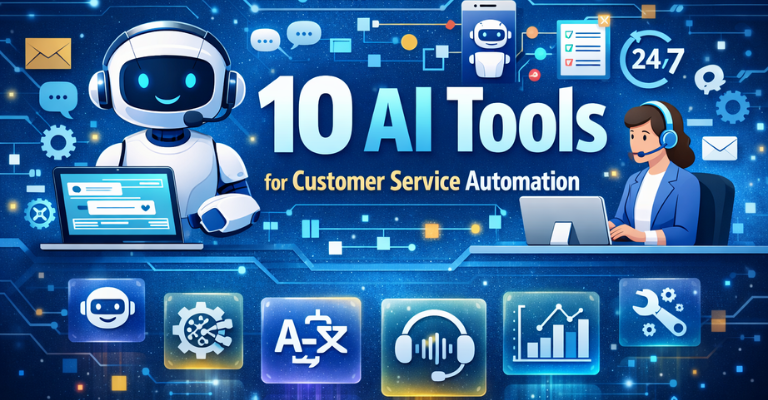
Here, in this blog, Mr Kiran Kumar Dwivedi, the leading digital marketing trainer at TrafficDuniya, provides his insight into the top 10 AI tools for customer service automation. These tools help businesses work faster, give better customer service, and grow more effectively.
Introduction to AI in Customer Service Automation
AI is changing how businesses provide customer service. Traditional support depends on human agents answering the same questions over and over. This can be slow and cause several mistakes. AI tools can handle many of these tasks automatically. They use technologies like natural language processing and machine learning to understand and answer customer questions very fast and accurately.
With AI, businesses can give faster and more accurate support. Chatbots, virtual assistants, and helpdesk AI can manage many conversations at once. They can send more complicated issues to human agents when needed. This helps customers get answers quickly and improves their experience.
AI in customer service gives useful insights. It can find patterns, spot common problems, and suggest ways to improve products and services. Businesses can use this information to make smarter decisions and give customers the best experience.
AI is not meant to replace human agents. It can help them work faster and also ensures customers get smooth as well as reliable support.
Why Use AI for Customer Service Automation
- Handles repetitive tasks: AI support bots can answer very simple and common questions like order status, account issues as well as FAQs. This allows human agents focus on difficult problems.
- Provides quick responses: Chatbots answer questions immediately, so customers need not to wait.
- Works 24X7: AI never needs breaks. This allows businesses offer support anytime.
- Supports human agents: By handling simple questions, AI allows agents focus on complex issues that need care and attention.
- Reduces costs: AI lowers the need for big support teams while keeping service quality high.
- Speeds up resolutions: Automated responses and smart routing help solve problems quickly.
- Improves customer experience: Quick, accurate, and constant answers make customers happier and build trust.
- Grows with your business: AI support bots can easily handle many interactions as your business grows, without needing extra staff.
- Tracks customer behavior: AI can find patterns, spot common problems, and suggest changes for products or services.
- Ensures accuracy: AI always uses updated knowledge bases, giving constant and correct answers every time.
Top 10 AI Tools for Customer Service Automation
1. Intercom Fin AI
Intercom Fin AI is an AI-powered chatbot and messaging platform that combines automated support with live agent handoff. It connects to your knowledge base and works good for businesses in SaaS, ecommerce, and subscription-based industries.
- Pros: Provides human-like conversational responses, supports multiple messaging channels, and adds support with sales workflows.
- Cons: Pricing can increase with usage and number of contacts. It may lack advanced ticketing features for high-volume support.
- Pricing: Base plans begin around $39 per seat, with additional charges for AI features.
- Unique Features: Combines support and sales automation, making it the best for growing SaaS, and e-commerce companies.
2. Freshdesk Freddy AI
Freddy AI is built into Freshdesk and Freshchat. It automates ticket classification, FAQ responses, and provides agent suggestions for very fast resolution.
- Pros: Affordable, easy to deploy, works across multiple channels, and reduces ticket volume.
- Cons: Less scalable for very large businesses. Basic AI may struggle with many complex queries.
- Pricing: Free tier available. Paid plans begin around $19 per agent per month.
- Unique Features: Strong integration within the Freshdesk ecosystem for small, and medium businesses.
3. Zendesk AI
Zendesk AI improves the Zendesk helpdesk suite with AI features like ticket triage, routing and auto-responses. The best for mature support operations with high ticket volumes.
- Pros: Strong ticketing and workflow management, multi-channel support, and deep integrations.
- Cons: It can be costly for smaller teams. May feel rigid for non-Zendesk users.
- Pricing: Starts at around $19 per agent per month; enterprise plans with complete AI features cost more.
- Unique Features: Advanced ticketing workflows with AI-powered recommendations, and analytics.
4. Ada
Ada is a no-code AI chatbot platform offering multilingual support and omnichannel deployment. Excellent for industries like retail, telecom, and finance
- Pros: Can handle many requests at once, easy for customers to use on their own, and works on many channels.
- Cons: Reporting, as well as analytics can be limited. Requires some setup to work properly.
- Pricing: Custom pricing depends on volume as well as channels
- Unique Features: It focuses on multilingual support, and large-scale automation for global brands.
5. Tidio
Tidio is a very lightweight AI chatbot and live chat platform. It is the best for small to medium businesses, especially e-commerce stores.
- Pros: Very easy to set up, affordable, as well as supports basic automation like FAQs and order tracking.
- Cons: Very limited scalability and advanced automation features.
- Pricing: Free plan available.
Paid plans start around $15–$29 per month.
- Unique Features: The best for small businesses that want a simple, as well as cost-effective AI support bot.
6. Botpress
Botpress is an open-source chatbot platform for technical teams. It allows full customization, on-premise, and cloud deployment.
- Pros: Highly customizable, integrates with internal systems, flexible workflows, and control over data.
- Cons: Needs technical knowledge. Setup and maintenance take more effort than plug-and-play solutions.
- Pricing: Free and paid plans available; paid plans can go up to around $446 per month.
- Unique Features: Developer-friendly platform for businesses needing bespoke chatbot solutions.
7. Robylon AI
Robylon AI is a no-code AI agent platform. It is good for omnichannel customer support. It integrates with CRMs, and handles high-volume ticket resolution.
- Pros: It requires no-code setup, and supports many channels. It has high automation rates, as well as reduces support costs.
- Cons: Flexibility is very limited compared to developer-centric platforms; very complex workflows may need customization.
- Pricing: Free starter plan; paid plans range from $39 to $199 per month, with enterprise pricing available.
- Unique Features: High automation with easy deployment for businesses without any technical teams.
8. Drift AI / Conversational AI
Drift mixes chat-based support with sales, and lead qualification workflows. It allows businesses to manage pre-sales and post-sales support.
- Pros: Integrates lead capture, sales qualification, and customer support. Real-time routing improves response times.
- Cons: Not as strong for deep ticketing, as well as post-sale support.
- Pricing is high for small teams.
- Pricing: Custom enterprise-level pricing.
- Unique Features: The best for businesses that want to combine sales, and support in one AI platform.
9. Netomi
Netomi is a conversational AI platform for chat, email, and omnichannel support. It uses context-aware responses, and sentiment detection.
- Pros: Handles complex queries, scalable multi-channel support, and reduces load on human agents.
- Cons: Pricing is custom and mainly suitable for big companies. Customization options and reporting tools may feel limited.
- Pricing: Custom pricing is designed for large enterprises.
- Unique Features: Offers strong natural language understanding and accurate sentiment analysis, making it useful for large support teams.
10. Zoho Desk and Zia AI
Zoho Desk with Zia AI provides helpdesk automation with ticket tagging. It offers sentiment detection, and basic AI assistance. It is the best for small businesses on a budget.
Pros:
- Low cost
- Automates ticket workflows.
- Integrates well with other Zoho products.
Cons:
- AI features are basic compared to enterprise-grade platforms.
- Advanced reporting is very limited.
Pricing: Starts at around $7 per agent for a month.
Unique Features: Budget-friendly AI helpdesk for small businesses, and startups.
Comparison Table
| Tool | Overview | Pros | Cons | Pricing | Unique Features |
| Zendesk AI | AI layer built inside the Zendesk helpdesk system. | Easy setup, strong automation, accurate response suggestions. | Costly for small teams. | Added cost on top of Zendesk plans. | Smart ticket triage, sentiment analysis. |
| Freshdesk Freddy AI | AI assistant used inside Freshdesk. | Great for ticket management and workflow automation. | Works best only within Freshdesk. | Available in higher-tier plans. | Intent detection and AI-powered reply suggestions. |
| Intercom Fin AI | AI chatbot for websites and mobile apps. | Natural conversations, learns from your content. | Price increases with usage. | Pay-per-resolution model. | Answers based on website or help center data. |
| Drift AI | AI chatbot focused on sales and customer support. | Strong for lead qualification and quick responses. | More sales-oriented than support-focused. | Custom pricing. | Personalized user journeys based on past behavior. |
| LiveChat + ChatBot | AI chatbot builder connected with LiveChat. | Simple drag-and-drop bot creation. | Limited advanced NLP capabilities. | ChatBot plan sold separately. | Visual bot builder for automation flows. |
| HubSpot Service Hub AI | AI features inside the HubSpot service platform. | All-in-one CRM and helpdesk AI in one place. | Advanced tools only in expensive tiers. | Free version available, upgrades paid. | AI email replies, automated ticket routing. |
| Zoho Desk Zia AI | AI assistant built into Zoho Desk. | Affordable and good for small to medium businesses. | NLP less advanced compared to top tools. | Mid and high-tier plans. | Predictive ticket sentiment and priority ranking. |
| Ada AI | Enterprise-grade chatbot for support automation. | Highly customizable and accurate. | Suited mainly for large companies. | Custom enterprise pricing. | Multilingual AI with deep training options. |
| Tidio Lyro AI | AI chatbot designed for small businesses. | Easy setup and budget-friendly. | Limited advanced features for large teams. | Free and paid tiers available. | Answers directly from uploaded FAQs. |
| Helpshift AI | AI for mobile apps and in-app customer support. | Great for app-based businesses, fast automation. | Interface has a learning curve. | Custom pricing. | In-app messaging and automated workflows. |
Tips for Choosing the Right AI Tool for Customer Service Automation
- Understand your needs: First of all, clearly find out what you want to achieve with AI tools for customer service. Knowing your goals helps you select a tool that matches your business needs. Whether you want to reduce response time, handle more customer requests, or support your team in managing tickets, understanding your needs ensures you select the right features. A clear plan not only helps avoid spending on tools you don't need but also makes implementation smoother as well as more effective.
- Choose a tool that is easy to use: The AI tool should be simple to set up and manage. If your team does not have strong technical skills, select a platform that offers a clean dashboard, guided setup, and ready-made workflows. This helps reduces the learning time, and you get started faster.
- Check the features you get: Make sure the tool offers all the features your business requires. They can include chat automation, email support, live chat, ticketing management, analytics, or integration with your knowledge base. The right features can help you improve customer service without any extra manual work.
- Test how well the AI understands questions: A good AI should clearly understand customer queries as well as respond accurately. Find out the tools that use natural language processing and have high accuracy. Poor understanding can lead to wrong answers and unhappy customers.
- Check integration options: Your AI tool should connect easily with your CRM, website, e-commerce store, apps, and social media channels. Smooth integration enables the AI to utilise customer history, order details, and other relevant data to provide more effective support.
- Think about scalability: Choose an AI tool that can grow with your business. As your business grows, the AI tool should automatically manage more chats, tickets or requests without slowing down or needing major upgrades.
- Check customer support from the provider: Best onboarding, training and help resources are very important. Choose a platform that offers helpful documentation, tutorials and a support team that replies quickly when you require help.
- Compare pricing carefully: Different tools charge based on users, ticket volume, or AI usage. Pick a plan that fits your budget. Confirm whether there is an additional cost for advanced features, bots, add-ons, and higher usage, or not.
- Review security & data protection: Customer data is sensitive. So, the tool should follow strong security standards. Look for features like data encryption, access control, and compliance with privacy rules. This keeps customer information safe.
- Try a free trial before deciding: Many AI tools offer a free trial or demo. Get it to test the features and see how well the tool fits your support needs. This helps you know the tool better and make a confident decision.
Conclusion
Whether you run a startup, a small business, an online store, or a large company, an AI customer service tool can help. The main point is to select a tool that matches your business size, your customers, and your long-term goals. AI does not replace human teams. It helps them work more efficiently, reduces repetitive tasks, as well as ensures customers receive quick and reliable support.
AI tools can turn customer service from slow and reactive to smart and aggressive. With fast replies, 24-hour support, and better problem tracking, businesses can build trust and offer a smoother experience. This can lead to higher customer satisfaction, stronger loyalty as well as a better brand image.
When you pick the right AI platform and use it properly, your business run smoothly, get faster resolutions, as well as useful insights that support growth. AI-powered customer service is now becoming the new standard, and adopting it early offers your business many advantages.
If you want to explore more advanced AI options, make sure to read our guide on the 100 AI tools that are shaping the future of business, and technology. It will help you understand new AI tools, trends, as well as innovations that can upgrade your complete digital strategy.
Ready to upgrade your customer support with AI? Connect with TrafficDuniya today and get expert guidance to select the right tools, set them up correctly, and build a powerful customer service system that grows with your business.
Written By:
Name: Kiran Kumar Dwivedi
Designation: Digital Marketing Trainer, Writer, & Growth Strategist
Degree: MBA – Digital Marketing
Experience: 20+ Years
Leads Generated: 10 Lakhs+
.png)