Recruitment is growing faster than ever. HR teams are facing many new challenges like huge volumes of applications, a shortage of skilled talent, and the pressure to hire fast without compromising quality. Manual processes are no longer enough to complete the tasks. Modern HR departments are increasingly turning to AI hiring tools and resume screening AI to streamline workflows, identify top talent, and make smarter hiring decisions.
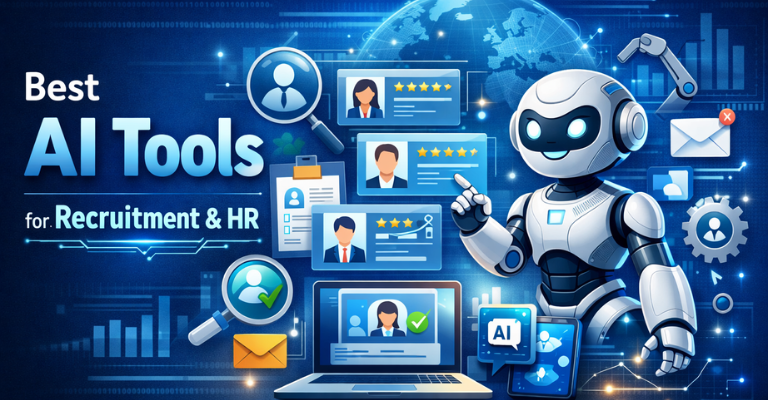
In this blog, Mr. Kiran Kumar Dwivedi, a renowned growth strategist at TrafficDuniya, shares insights into the best 10 AI tools for recruitment and HR Additionally, how AI is revolutionizing recruitment, and tips for HR professionals to use AI easily.
Introduction to AI for Recruitment & HR
Artificial Intelligence (AI) is changing the way organizations attract, evaluate, and hire talent. In the past, recruitment depended completely on manual processes. HR teams needed to filter through countless resumes, conduct repeated interviews, and spend hours scheduling calls, often with mixed results. Today, AI is changing this by automating repetitive tasks, providing data-driven insights, and allowing smarter decision-making
At its core, AI in recruitment uses different algorithms and machine learning to analyze data, predict results, and determine patterns that human recruiters might miss. For example, resume screening AI can very quickly examine hundreds of applications, match candidates to job requirements, and rank them based on skills and experience. Similarly, AI hiring tools can engage candidates through chatbots, evaluate soft skills using gamified assessments, and even determine which candidates are likely to succeed in a role. The merger of AI in a HR process is not only about efficiency. It is all improving the quality of hiring while improving the candidate experience. By using AI tools, companies can easily reduce human biasness in early screening, make sure better matches between candidates and roles, and make informed decisions faster.
Why Use AI Tools for Recruitment & HR Process
AI has become an important part of a hiring process. Its benefits extend across every stage of recruitment:
1. Accelerating the Screening Process
- Manually reviewing hundreds or thousands of resumes is time-consuming. Resume screening AI can quickly review CVs, evaluate skills, and match candidates to job requirements.
- AI algorithms prioritize candidates who meet particular qualifications, reducing the time to shortlist by days or even weeks.
2. Identifying High-Potential Talent
- Traditional keyword-based matching can miss capable candidates. Advanced AI hiring tools analyze experience, skills, and career trajectory to discover hidden talent.
- This confirms recruiters' focus on candidates with the highest potential, not only the most obvious resumes.
3. Enhancing Candidate Engagement
- AI-powered chatbots can answer candidate questions, schedule interviews, and send updates automatically.
- This creates a smooth, and responsive candidate experience, increasing the chance of accepting offers.
4. Supporting Fairness and Diversity
- Discrimination in recruitment can affect a company's culture and performance. AI tools, when configured properly, can easily screen candidates based on skills and experience rather than demographic factors.
- Many platforms offer insights into a variety of metrics, helping HR maintain equitable hiring practices.
5. Data-Driven Decision Making
- AI provides analytics that reveals hiring trends, source effectiveness and candidate quality.
- HR teams can use these insights to improve recruitment strategies, improve employee retention, and optimize workforce planning.
Top 10 AI Tools for Recruitment and HR
1. Eightfold AI
Eightfold AI is also known as an intelligence platform. It uses AI to match candidates to jobs based on their skills, experience, and potential. Additionally, this platform helps with internal promotions and workforce planning.
Pros:
- It finds very talented candidates that traditional keyword searches might miss.
- It shows future skill gaps, and possible career paths.
- It also helps with promotions, and planning for the future employment.
Cons:
- It can be tough for a very small HR team to learn.
- Connecting it with older systems can be tricky.
- Best for medium to large enterprises.
Pricing:
Custom enterprise pricing, with small-scale plans starting around $650 for a month.
2. HireVue
HireVue is a video interview and assessment platform. It uses AI to study a candidate’s answers, tone as well as communication style. It supports structured interviews and works well for large-scale hiring.
Pros:
- Handles high-volume interviews easily.
- Structured assessments reduce interviewer bias.
- Works smoothly with most ATS platforms.
Cons:
- Expensive and mainly for large companies.
- Depending too much on video AI may miss human qualities.
- Not good for highly technical roles.
Pricing:
Begins at around $35,000 per year for enterprise packages.
3. Pymetrics
Pymetrics uses game-based tests to assess candidates. It measures their thinking ability, personality and soft skills. It focuses on a candidate’s potential, not only their resume.
Pros:
- Supports fair and variety of hiring.
- Great for campus and early-career recruitment.
- Gives insights that resumes alone can’t show.
Cons:
- Game-style tests may not suit everyone.
- It is not good for very technical, and specialized roles.
Pricing:
Custom pricing based on the need and size of the company.
4. hireEZ
hireEZ is a candidate sourcing and engagement platform. It collects profiles from many online sources, builds talent pipelines, and automates outreach.
Pros:
- Huge candidate database for both active and passive talent.
- Automates outreach and follow-ups, saving recruiters time.
- Integrates well with ATS and CRM platforms.
Cons:
- Candidate contact information may occasionally be outdated.
- It can be overkill for small hiring teams.
- Pricing and plans can vary.
- No transparency in cost.
Pricing:
- Starting plans are around $169 per user/month.
- The cost can be higher for professional/enterprise tiers.
5. Humanly
Humanly is a casual AI platform for candidate screening, communication, and scheduling. It is especially effective for high-volume roles needing soft skills and engagement.
Pros:
- Automates early-stage candidate interaction and screening.
- Focuses on soft skills and communication quality.
- Merge well with ATS and existing hiring workflows.
Cons:
- Not good for technical or niche roles.
- May not handle very high-volume hiring that needs detailed assessments.
- Custom pricing may be too costly for smaller companies.
Pricing:
Custom pricing based on hiring volume and required features.
6. XOR
XOR is a conversational AI assistant. It automates candidate screening, scheduling, and communication via chat, SMS, and messaging apps.
Pros:
- Automates repetitive tasks like scheduling and FAQ responses.
- Great for high-volume, shift-based, and frontline roles.
- Quick and very easy to set up.
Cons:
- Not suitable for advanced or technical skill assessments.
- Enterprise pricing can be too expensive for small companies.
- Analytics and customization options are not as strong as bigger platforms.
Pricing:
Custom pricing depending on company size and candidate volume.
7. Textkernel
Textkernel is a semantic resume parsing and matching tool. It analyzes resumes based on context, not only keywords. It helps HR teams screen a very large volume of applications effectively.
Pros:
- Handles different resume formats.
- Contextual matching improves candidate fit accuracy.
- Speeds up resume screening significantly.
Cons:
- Primarily focused on resumes; less useful for video or behavioural assessment.
- Requires integration with ATS for maximum effectiveness.
- It can be complex to set up initially.
Pricing:
Generally enterprise-level, with custom quotes according to the usage.
8. Lever
Lever is a talent acquisition and applicant tracking platform. It combines AI-powered sourcing with end-to-end hiring workflows.
Pros:
- Simplify workflow from the sourcing to hiring.
- AI matching helps target the right candidates.
- Best for medium to large companies.
Cons:
- Not good for very small businesses with low hiring needs.
- Full AI features may require premium plans.
- It may take time to set up and learn for teams new to ATS
Pricing:
- Starts around $99 per user per month for basic plans,
- The cost of enterprise plans may be higher.
9. Convin AI VoiceBot
Convin AI VoiceBot automates candidate pre-screening through voice interactions, The best for high-volume or repetitive hiring processes.
Pros:
- Screens large candidate pools quickly.
- Reduces recruiter workload.
- Consistently evaluates candidates during pre-screening.
Cons:
- Very limited to technical or specialized roles.
- Cannot replace detailed interviews.
- Pricing is usually custom, based on volume.
Pricing:
Custom enterprise pricing.
10. SkillPool
SkillPool focuses on skills-based assessment and screening. The tool assess candidates on their practical competencies rather than academic credentials.
Pros:
- It focuses on practical skills and real work experience.
- Reduces stress on formal education.
- Useful for technical, operational, or vocational roles.
Cons:
- It may not capture soft skills or cultural fit.
- May not capture soft skills and cultural fit.
- Needs complementary assessment tools for complete evaluation.
Pricing:
Pricing is custom or subscription-based, depending on how many assessments you need.
Comparison Table
| Tool | Overview | Pros | Cons | Pricing |
| Eightfold AI | Matches candidates based on skills, experience, and potential; supports internal mobility. | Uncovers hidden talent; workforce planning. | Steep learning curve; complex integration. | From $650/month |
| HireVue | Video interview & assessment platform analyzing responses and communication. | Scalable; structured assessment; ATS integration. | Expensive; may overlook nuances. | From $35,000/year |
| Pymetrics | Gamified behavioral & cognitive assessment for personality and potential. | Promotes diversity; ideal for early-career hiring. | Less suited for technical roles; high cost. | Custom pricing |
| hireEZ | Sourcing & engagement platform; aggregates candidate profiles. | Large database; automated outreach. | Contact info may be outdated; overkill for small teams. | From $169/user/month |
| Humanly | Conversational AI for screening, communication, and scheduling. | Automates screening; focuses on soft skills. | Limited for technical roles; custom pricing. | Custom pricing |
| XOR | AI assistant for screening, scheduling, and messaging. | High-volume hiring; fast deployment. | Limited skill assessment; expensive for small firms. | Custom pricing |
| Textkernel | Semantic resume parsing & matching tool. | Handles diverse resumes; speeds up screening. | Needs ATS integration; setup complexity. | Enterprise-level pricing |
| Lever | Talent acquisition & applicant tracking with AI sourcing. | Streamlines workflow; improves candidate targeting. | Less suited for small companies. | From $99/user/month |
| Convin AI VoiceBot | Automated voice-based candidate pre-screening. | Screens large pools quickly; consistent evaluation. | Limited for technical roles. | Custom pricing |
| SkillPool | Skills-based assessment focusing on practical competencies. | Highlights skills over formal education; ideal for technical roles. | May miss soft skills; needs complementary tools. | Custom/subscription pricing |
Tips for Choosing the Right AI Recruitment Tool
Choosing the right AI hiring tool or resume screening AI can make a notable difference in your recruitment efficiency and candidate quality. Here are some important tips to guide your decision:
1. Identify Your Hiring Needs
Before choosing an AI tool, know your hiring needs. Are you hiring for high-volume roles, technical positions, or entry-level jobs? Do you need help with resume screening, soft skills assessment, or finding passive candidates? Pick a tool that matches your needs to get the best results.
2. Consider Candidate Volume and Type
Some AI tools are good for high-volume roles, like frontline or seasonal jobs. Others work best for specialized or senior positions. Think about how many candidates you usually handle. Also consider the complexity of the roles. Resume screening AI is great for filtering many applicants. AI interview tools are better for checking cultural fit and communication skills.
3. Evaluate Integration Capabilities
Choose an AI tool that works well with your ATS, HR software as well as communication platforms. Good integration reduces manual work, avoids data duplication, and keeps hiring smooth. It also helps track metrics, automate tasks like emails and scheduling, and adapt as your hiring needs grow.
4. Assess Features Beyond Screening
Choose tools that do more than only screen resumes. Look for features like predictive analytics, talent rediscovery, internal mobility, chatbots, and automated interview scheduling. These tools can save time and enhance the candidate experience. Tools with advanced analytics also help HR teams make data-driven decisions. Additionally, they plan future hiring strategies more effectively.
5. Prioritize Candidate Experience
When choosing an AI hiring tool, make sure it helps both HR as well as candidates. A positive experience is key to keeping your employer brand strong. Look for tools with clear communication, very simple interfaces and fair assessment methods. Tools that guide candidates step by step, give timely feedback, and are easy to use can boost satisfaction and acceptance rates. Remember, a poor candidate experience can spoil your company's reputation and make it difficult to attract top talent.
6. Check for Bias and Fairness
AI tools are powerful, but they should be fair. Make sure the tool includes bias mitigation techniques to promote diversity and inclusivity in hiring. A good AI hiring tool prevents unintentional discrimination depending on gender, age, ethnicity, and education. By removing discrimination, you can easily focus on a candidate’s skills, potential, and fit for the role. Using a fair AI tool is not only ethical but can help companies build stronger, various teams that perform better.
7. Review Reporting and Analytics
Strong analytics are very important to help make data-driven hiring decisions. Look for AI tools that provide clear insights into candidate pipelines, skill gaps, recruitment bottlenecks, and overall hiring efficiency. These reports help HR teams understand where improvements are needed, identify trends, and optimize recruitment strategies. Tools with predictive analytics can easily forecast hiring results and help you plan for future talent requirements. Good reporting makes sure the hiring decisions are smart, measurable, and aligned with the organizational goals.
8. Evaluate Scalability and Flexibility
Your hiring needs will change as your company grows. Choose AI tools that can grow with your organization. Look for flexible features, subscription options, and customizable workflows. Adaptable platforms stay useful even as your hiring requirements evolve. Scalable solutions can save time, money and effort because you need not to switch tools frequently. Flexibility allows you to add new processes, AI features, and assessment types when needed.
9. Consider Budget
AI hiring tools can range from very affordable plans for small startups to expensive enterprise solutions costing 10,000 per year. Before buying, check your budget and compare it with the expected ROI. Think about your hiring volume, the complexity of roles, and long-term benefits. A higher-priced tool can be worth it if it saves your time, improves candidate quality, and improves overall HR efficiency.
10. Test Before Committing
Always ask for a demo or trial before fully committing to a tool. Testing helps your team check usability, integration, accuracy, and overall value. It also shows if the tool fits your current recruitment workflow and meets your hiring goals. A trial can prevent costly mistakes and ensure the AI tool truly adds value to your hiring process.
Conclusion
AI is no longer only a promotion. It is now a key part of modern recruitment and HR. This is especially true for organizations handling many candidates or aiming for fair, data-driven hiring.
Using AI hiring tools and resume screening AI can easily save time, reduce discrimination, and improve candidate quality. These tools free HR teams to focus only on meaningful human interactions, team building and long-term success. However, AI is not magic. It needs careful implementation, human oversight, and clear policies. Regular evaluation ensures fairness, compliance, and a good candidate experience.
For organizations in India or other emerging markets, investing in the right AI recruitment tools like sourcing, screening, assessment, and ATS integration can provide a strong competitive hiring advantage.
Boost your business with TrafficDuniya! Get expert digital marketing solutions that drive traffic, generate leads, and grow your brand. Connect with our digital marketing experts today to take the online presence to the next level.
Discover the future of work! Explore our latest blog on 100 AI Tools to Change the World and learn how the latest AI innovations can easily transform your business and recruitment strategy.
Written By:
Name: Kiran Kumar Dwivedi
Designation: Digital Marketing Trainer, Writer, & Growth Strategist
Degree: MBA – Digital Marketing
Experience: 20+ Years
Leads Generated: 10 Lakhs+
.png)